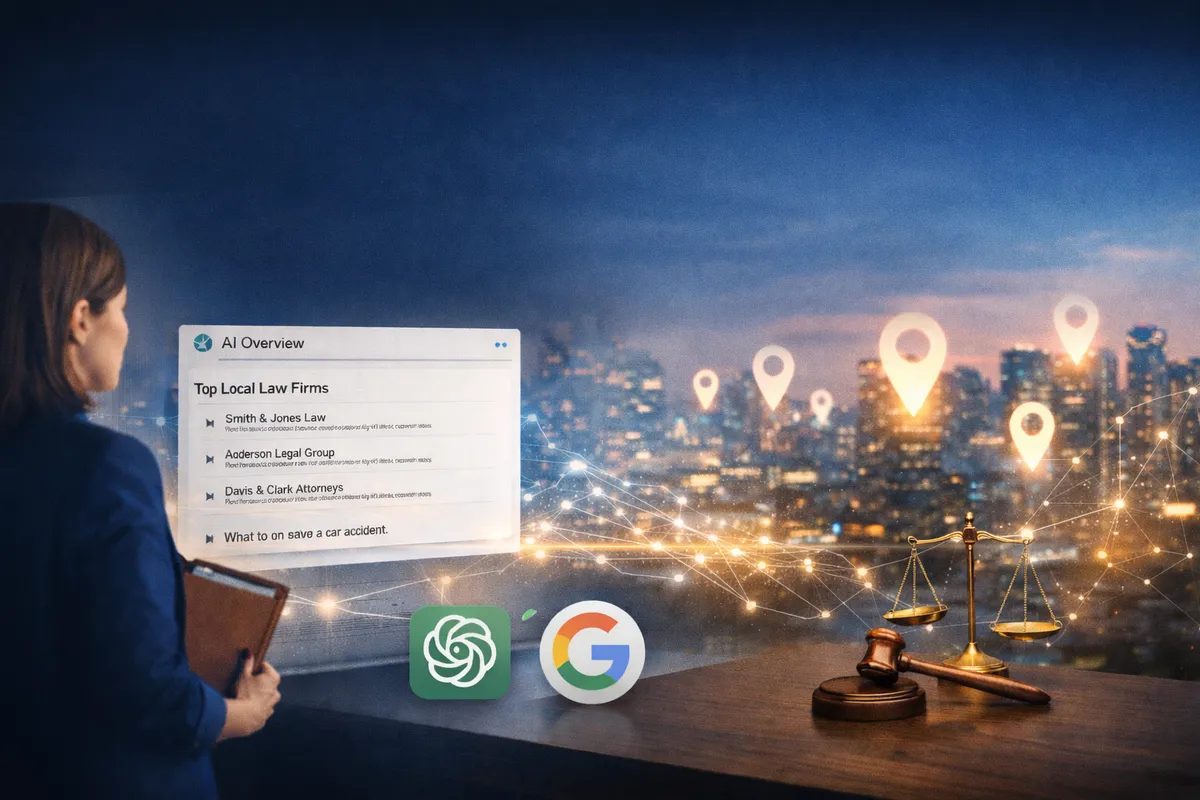
Showing up first on Google doesn’t mean what it used to. In fact, clicks on the top result have dropped by almost a third since Google started rolling out AI summaries. Even the sites that used to dominate page one are seeing way fewer visits because people are just reading the AI answer instead of clicking through.
And this isn’t rare, those AI summaries are showing up in nearly one out of every three searches, and in most cases where someone is asking a question or looking to solve a problem.
So here’s the hard truth: if your content isn’t built to be the answer inside those AI responses, your business might be invisible… even if you think you’re ranking.”
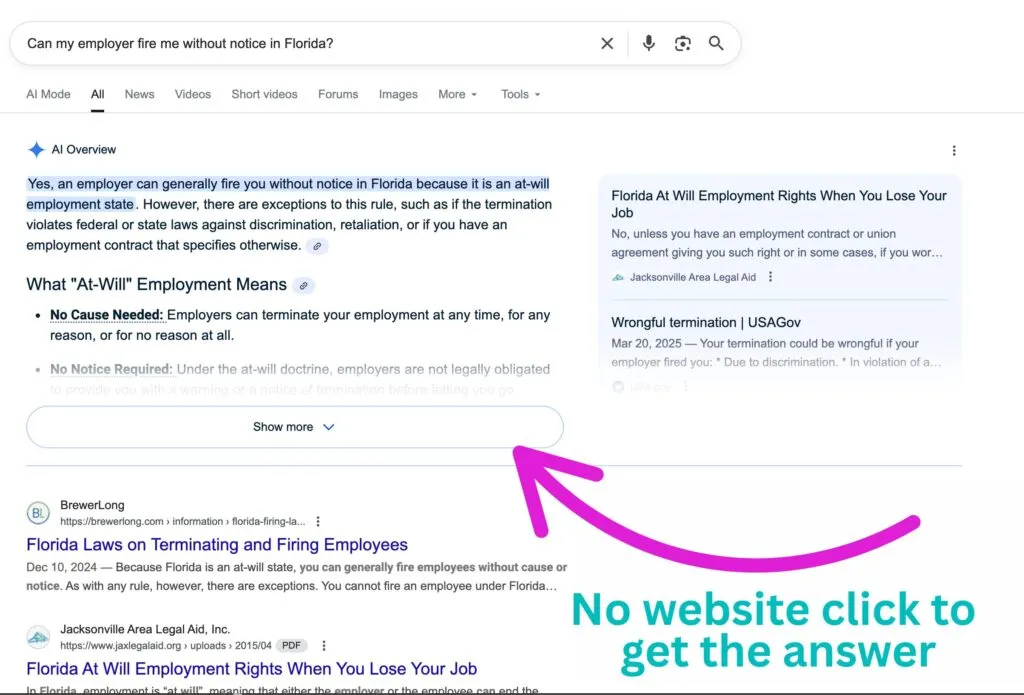
Example: Google’s AI Overview Answering Legal Questions
When you Google a legal question like “Can my employer fire me without notice in Florida?”, the very first thing you see isn’t a website link, it’s Google’s AI Overview.
That box at the top gives a clear, direct answer: “Yes, an employer can generally fire you without notice in Florida because it is an at-will employment state.” It even lists exceptions.
Notice what’s missing? The need to click through.
- The user’s question is answered right there on the page.
- The AI pulls in information from multiple sites, but instead of sending traffic to those websites, it condenses the answer and keeps the user in Google’s ecosystem.
- Only if someone wants to dive deeper would they scroll down and click a link, but most people won’t.
Why AI Overviews Steal Website Traffic
- Zero-click searches are now the norm. The AI summary gives people enough of an answer to stop searching.
- Even if your firm wrote one of the cited sources, you may never see the traffic.
- For legal, medical, and financial questions especially, users are more likely to skim the AI box and move on.
This changes the playbook. Ranking on page one isn’t enough anymore.
The real strategy is making sure AI engines like ChatGPT, Gemini, and Google’s own AI Overviews are pulling your content when they answer a question. That strategy is called GEO, and it’s quickly becoming just as important as SEO.
Generative Engine Optimization (GEO) is all about making sure your business shows up inside AI-generated answers, not just on Google’s list of links. Instead of focusing only on ranking high in search results, GEO is about structuring your content so tools like Google’s AI Overviews, ChatGPT, and Gemini see it as the best possible answer. Think of it this way: SEO gets people to click, but GEO makes sure you’re the answer even when no one clicks at all.
SEO vs. GEO Comparison Table
| Aspect | SEO (Search Engine Optimization) | GEO (Generative Engine Optimization) |
|---|---|---|
| Main Goal | Get ranked high in Google so users click to your website | Get your content cited or mentioned inside AI answers |
| User Behavior | People scan results and choose a link to click | People read AI summaries without clicking |
| Visibility | Appears in search engine results pages (SERPs) | Appears directly in AI Overviews or chat responses |
| Tactics | Keywords, backlinks, page speed, mobile optimization, schema | FAQs, listicles, comparison tables, structured content, publishing on AI-friendly platforms |
| Metrics | Click-through rate (CTR), organic traffic, keyword rankings | Mentions in AI tools, brand visibility, branded searches (even without clicks) |
| Timeframe | Long-term, ongoing | Emerging, with first-mover advantage now |
| Big Risk if Ignored | You don’t rank well and lose traffic | You become invisible in AI results, even if you rank on page one |
Why GEO Matters for Businesses
It’s easy to look at SEO vs. GEO as theory, but the impact is very real. If AI is answering questions before people ever click a website, the businesses that don’t adapt get left behind. And it’s not just happening in tech, it’s hitting everyday industries where people rely on search the most. Here’s what it looks like in practice:
Law Firms
If someone searches “employment lawyer near me” or “Can I sue for unpaid overtime in Florida?”, Google’s AI Overview may give a full answer, sometimes even naming a few firms. If your firm isn’t included, potential clients may never even see your website, no matter how good your SEO rankings are.
Service Businesses (Plumbers, Electricians, HVAC, etc.)
Think about a homeowner searching “best plumber near me” or “how much does it cost to replace an electrical panel?”. Instead of clicking through to your site, people can now get an instant estimate or list of providers directly from AI. If your business isn’t part of those answers, the phone may never ring.
Medical & Healthcare Practices (Dentists, Med Spas, Therapists)
Someone asks “Is Botox safe?” or “dentist open late near me”, and AI summarizes everything, often pulling from big review sites or health blogs. If your practice isn’t represented in those summaries, you lose visibility before patients even have the chance to discover you.
Restaurants & Hospitality
Searches like “best Italian restaurant in Sarasota” or “family-friendly hotel near Tampa” often trigger AI Overviews that list options straight from Yelp, TripAdvisor, or Google reviews. If your business isn’t in that AI-powered list, diners and travelers may never click through to your site.
E-Commerce & Retail
Queries like “best skincare products for acne” or “running shoes under $100” get AI-generated product roundups. Smaller brands risk being invisible if AI pulls only from Amazon or big-box retailers.
Education & Coaching
When someone asks “best coding bootcamps” or “career coaching near me”, AI tools tend to summarize rankings and reviews from major platforms. Smaller schools and independent coaches often get left out of those summaries unless they’ve optimized for GEO.